When an Australian searches “mechanic near me,” they almost never scroll. They glance at the three businesses Google shows on the map, tap one, and call. That three-business box decides who gets the customer, and google maps optimisation is the discipline of getting your business into it and keeping it there.
Most guides on this topic are thin checklists. This one goes deeper, because the businesses winning the map in 2026 are not winning by accident. This guide covers exactly how Google ranks local results, the factors that actually move you, the mistakes quietly holding you back, a step by step optimisation process, and how to measure whether any of it is working.
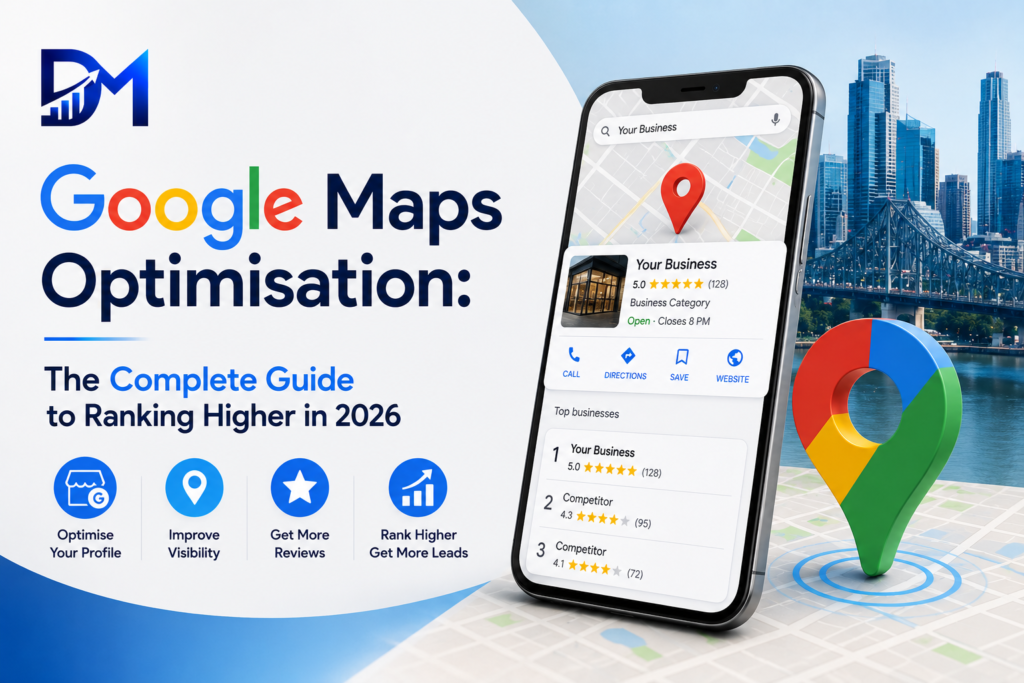
What Google Maps optimisation actually is
Google maps optimisation is the process of improving your Google Business Profile and its surrounding signals so your business ranks higher in Google Maps and in the local results of ordinary search.
It is worth separating from regular SEO. Traditional SEO is about ranking your website in the standard blue links. Maps optimisation is about ranking your profile, the listing with your name, reviews, hours, photos and a call button, in the map pack. For a local business, the map pack is where the phone calls live, which is why this work often matters more than your website ever will.
The thing people underestimate is that your profile is a living entity in Google’s eyes. It is not a static directory entry you set once. Google watches how complete it is, how active it stays, how people interact with it, and how the rest of the web talks about your business. Google maps optimisation is really about managing all of those signals on purpose instead of leaving them to chance.
How Google ranks local results: the three pillars
Google has been unusually open about this. Local ranking comes down to three factors, relevance, distance, and prominence, and understanding them deeply is the foundation of all google maps optimisation.
Relevance is how well your profile matches what someone searched. If a person searches “emergency electrician” and your profile is set up as a general electrician with no mention of emergency or after hours work, Google has less reason to show you for that search. Relevance is driven by your primary category, your secondary categories, the services you list, and the language across your profile and reviews. This is the most controllable pillar, and the one most businesses get wrong.
Distance is how far you are from the searcher, or from the location named in their search. You cannot change where you are, but you can influence which areas Google associates you with through your service area settings and the geographic signals around your business. Distance is also why a smaller business can beat a bigger one, because proximity to the searcher often outweighs raw size.
Prominence is how well known and trusted your business is. This is the slow burn pillar. It is built from your review quantity and quality, your review recency, your activity on the profile, your citations across the web, and the links and mentions pointing at your business. Prominence is what separates a profile that ranks occasionally from one that owns the top spot consistently.
Effective google maps optimisation means accepting that you cannot touch distance, then pushing relevance and prominence harder and more consistently than every competitor around you.
The Google Maps ranking factors that genuinely move the needle
Within those three pillars, certain levers do most of the work. If you want to know how to rank higher on Google Maps, focus your energy here, roughly in order of impact.
Primary category is the single highest leverage field on your profile. Google weights it heavily for relevance. A dentist who offers implants should still set the primary category as “Dentist,” then add “Dental implants provider” as a service or secondary category, not the other way around. Getting this one field right can outrank competitors who have done everything else.
Reviews matter across volume, rating, recency, and keywords. A steady stream of recent, genuine reviews is one of the strongest prominence signals there is. It is not just the star rating, because Google reads the text. Reviews that naturally mention your service and suburb, such as “great plumber in Newtown, fixed our hot water fast,” feed relevance too. A profile that earned forty reviews two years ago and none since looks stale next to one earning two a week.
Profile completeness counts. Every field should be filled: hours, services, attributes, description, products, and Q&A. Google rewards complete profiles because they serve users better, so empty fields are leaving ranking on the table.
Photos and activity signal a real, active business. Fresh photos and regular Google Posts show Google you are present, while profiles that go silent drift down. Activity is a prominence signal you fully control.
Citations and NAP consistency are essential. Your Name, Address and Phone number must be identical everywhere they appear online, across directories, your website, and social profiles. Inconsistent details, such as a “St” in one place and a “Street” in another, or an old phone number lingering on a directory, confuse Google and erode trust. Clean, consistent citations across Australian directories are a core part of google maps optimisation.
Website and on page signals still matter. A fast, locally relevant website with your suburb and services on it reinforces relevance and lends prominence to the profile.
Engagement signals close the loop. Clicks, calls, direction requests, and website visits from your profile all tell Google that people find you useful. You influence these indirectly, because a compelling, complete profile earns more interaction, which feeds back into ranking.
The mistakes quietly holding most profiles back
In auditing Australian profiles, the same problems come up again and again. Any one of these can cap your ranking no matter how much else you do right.
The wrong primary category is the most common and most costly. A business name stuffed with keywords, such as “Bob’s Plumbing Best Emergency Plumber Sydney Cheap,” violates Google’s guidelines and risks a suspension that makes you vanish entirely. Reviews that have dried up leave a stale profile. Inconsistent NAP details scatter across old directories. A profile that is verified but barely filled in wastes its potential. And no tracking at all means the owner has no idea whether they are moving up or down.
There is also the suspension trap. Google suspends profiles for reasons that are often opaque and sometimes unfair, such as a sudden edit, a flagged category, keyword stuffing, or an address that looks like a virtual office. A suspended profile drops off the map completely, and getting reinstated is a specific appeals process, not a waiting game. If your listing disappeared overnight, suspension is almost always why, and it needs handling before any other google maps optimisation work matters.
A step by step Google Maps optimisation process
Here is the sequence we actually follow, and the one you can run yourself if you have the time.
Step one is to claim, verify, and audit. Make sure you own and have verified the profile. Then audit honestly against competitors who outrank you: what categories do they use, how many reviews do they have, how recent are those reviews, and how complete are their profiles?
Step two is to nail relevance. Set the precise primary category. Add accurate secondary categories and every service, written the way customers search. Write a description that includes your services and suburb naturally, without stuffing.
Step three is to complete everything. Fill every field: hours including holiday hours, attributes, products, an opening date, a local phone number, and at least ten to fifteen real photos of your team, work and premises.
Step four is to build review velocity. Set up a simple system to ask every happy customer for a review, ideally right after the job. Reply to every review, old and new. Aim for consistency over bursts, because a steady trickle beats a one off flood.
Step five is to fix and build citations. Audit your NAP across the web, correct inconsistencies, and build listings on relevant Australian directories. Consistency is the goal, not volume.
Step six is to stay active. Post to your profile weekly, add fresh photos regularly, and answer questions in the Q&A. This ongoing activity is what holds your position once you have earned it.
Step seven is to measure. Watch your Google Business Profile insights and your rankings for the searches that matter, then optimise based on what the data shows rather than guesses.
Done properly, this is google maps optimisation as a continuous discipline rather than a one time setup, which is exactly why most DIY attempts stall after the initial enthusiasm fades.
How to measure whether it is working
Vanity metrics will mislead you. The numbers that actually matter are your ranking for the specific search terms your customers use, and from the locations they search, your profile interactions such as calls, direction requests and website clicks, and ultimately the leads and jobs that result. A profile climbing the rankings but generating no calls usually has a relevance or conversion problem worth investigating. Good google maps optimisation ties every change back to calls and customers, not just position.
Where Dignis Media fits in
We run google maps optimisation as an ongoing programme: precise category and relevance setup, review velocity systems, citation cleanup across Australian directories, suspension recovery when needed, weekly activity, and reporting tied to calls rather than vanity rankings. You get a named account manager you can reach on WhatsApp, transparent weekly reporting, and no lock in contract. We work across Sydney, Melbourne, Brisbane, Perth and Adelaide, and we focus solely on Australian local ranking.
Related services: Meta Ads · GMB SEO · Google Ads · Website SEO
City guides: GMB SEO in Sydney · GMB SEO in Melbourne · GMB SEO in Brisbane
What it costs and how long it takes
On timeline, expect early movement within the first month and a genuine shot at the local 3-pack over two to three months, longer in brutally competitive categories. Anyone promising the top spot in a few days is either guessing or using shortcuts that get profiles suspended. For the official position, Google sets out its local ranking factors here.
Frequently asked questions
How long does Google Maps optimisation take to work? Early movement is common within 30 days, and strong 3-pack positioning typically builds over 60 to 90 days.
What is the most important ranking factor? Your primary category for relevance, and steady recent reviews for prominence. Get those two right before anything else.
Why did my business disappear from Google Maps? Most often a suspension, an unverified profile, or details Google stopped trusting. All are recoverable with the right process.
Do I need a website to rank on Maps? No, but a fast, locally relevant website strengthens both your rankings and your conversions.
How many reviews do I need? There is no magic number. What matters is being competitive with the businesses outranking you, and keeping new reviews coming in.
Is Google Maps optimisation the same as SEO? They are related but distinct. SEO ranks your website, while this ranks your profile in the map pack. Most local businesses need both.
If you take one thing from this
The businesses owning Australia’s map results are not the biggest or the oldest. They are the ones whose profiles are the most relevant, the most complete, and the most alive. Every one of those is fixable. That is the entire promise of google maps optimisation: show us where you rank now, and we will map the exact path to the top 3.