A ghost listing is haunting Google Maps right now, and it might be stealing your customers. There is a hardware store in a quiet Australian suburb that closed its doors in 2022. The owner retired, the shopfront became a laundromat, the business ceased to exist. And yet three years later, search “hardware store near me” in that suburb and it still appears, still ranking above shops that are open, staffed, and desperate for customers.
That is a ghost listing: a dead business that refuses to leave the map. If you have ever lost to a competitor that looks oddly outdated, with an old logo, no recent reviews, and an air of neglect, you may be fighting a ghost listing without knowing it. These zombie profiles are one of the strangest problems in local search, and almost nobody talks about them. Let us fix that.
What exactly is a ghost listing?
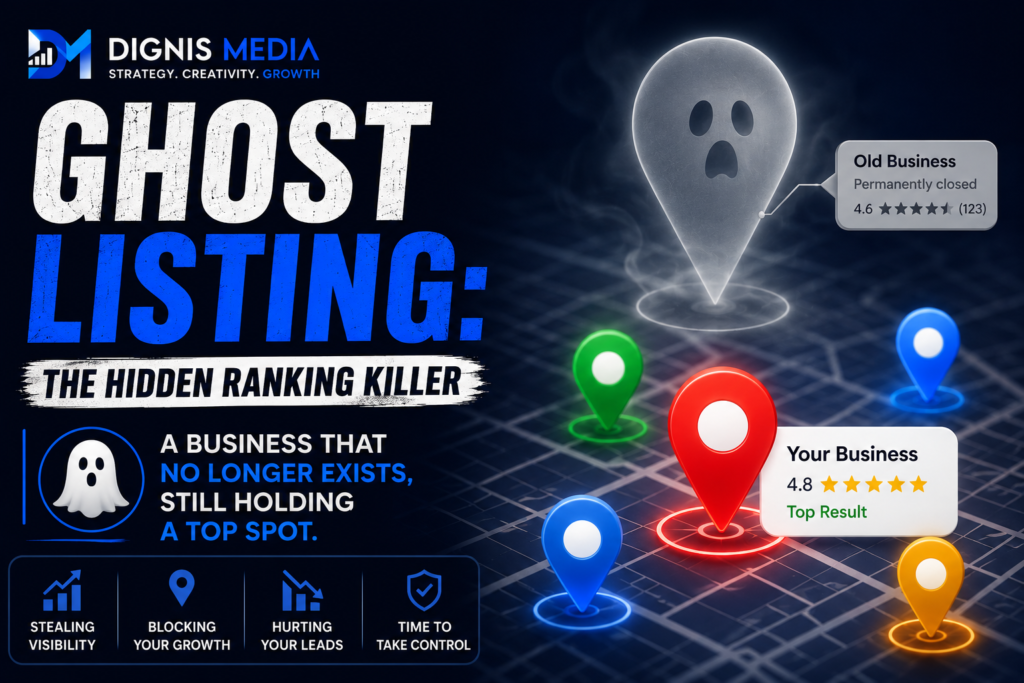
A ghost listing is a Google Business Profile that no longer represents a real, operating business but still exists and still ranks on Google Maps. It is a profile that outlived the business it belonged to.
They come in a few forms. Some are closed businesses whose owners never marked them closed, so Google still thinks they are open. Some are duplicate listings, an extra profile created years ago and forgotten. And some are leftovers from a business that moved, rebranded, or changed hands, abandoned like a shed skin. Whatever the origin, a ghost listing occupies a map spot that should belong to a living competitor. Possibly you.
Why a ghost listing can still outrank you
This is the part that makes owners furious, and it comes down to prominence. A ghost listing often carries years of accumulated history that a newer, active business simply has not built yet.
That closed hardware store had a decade of reviews, a long-established address, countless old citations, and years of Google trust baked in. When it closed, none of that vanished overnight. Google kept ranking the ghost listing on the strength of its history, unaware the doors were shut. Meanwhile a genuine competitor who opened last year, with fifteen reviews, cannot yet match that accumulated weight.
So the ghost listing wins, not because it is better, but because it is older and nobody told Google it died. It is coasting on a reputation it can no longer earn. That is the eerie, unfair heart of the problem.
How to spot a ghost listing beating you
How do you know the competitor above you is actually a ghost listing? Look for the tell-tale signs.
The reviews stop abruptly at some point in the past, with nothing recent. The photos are old and never refreshed. The website link is dead or redirects somewhere odd. The phone goes unanswered or is disconnected. The hours look generic and unchanged for years. And sometimes, the address now houses a completely different business.
Individually, each sign can be innocent. Together, they reveal a ghost listing, a profile ranking on past glory while the business behind it is long gone.
How to beat a ghost listing
Here is the good news. You are not powerless against a ghost listing. You fight on two fronts.
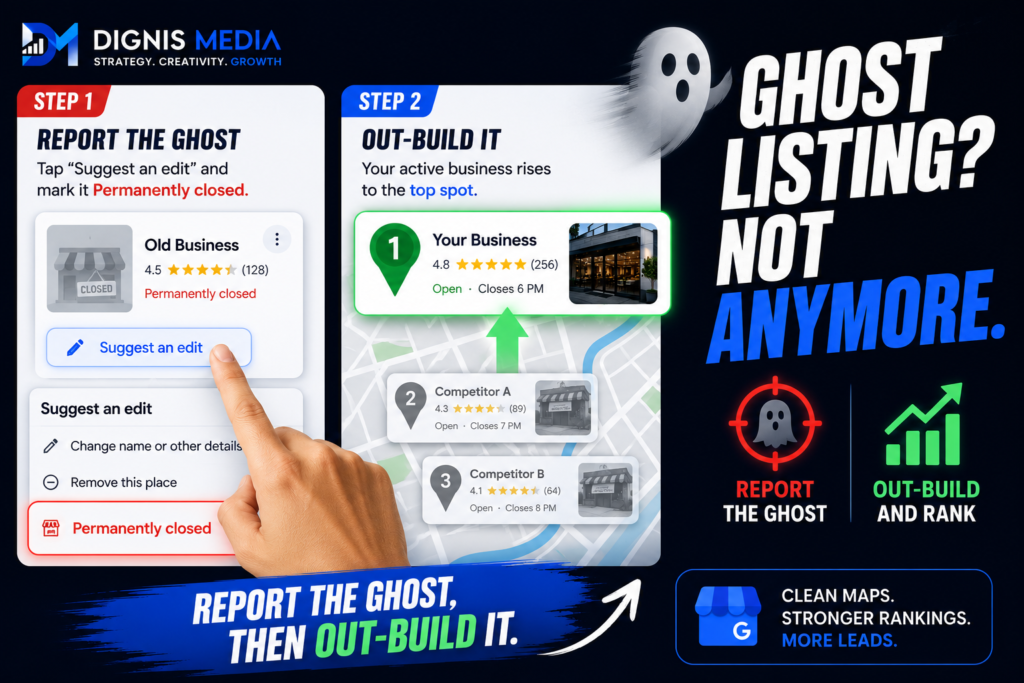
First, report it. If a business has genuinely closed, use the “Suggest an edit” feature on the listing to mark it permanently closed, or report it as a duplicate. Google reviews these suggestions, and while it is not instant, legitimate reports of a closed or duplicate ghost listing do get actioned. Removing it clears the spot it was unfairly holding, which often falls to the next strongest active business.
Second, out-build it. A ghost listing cannot fight back. It cannot earn new reviews, add photos, or stay active, because nobody is home. That is its fatal weakness. While it fades on old history, you build fresh prominence, steady reviews, regular photos, constant activity, that eventually overtakes its ageing signals. Time is on your side, because you are alive and it is not.
Why a ghost listing is secretly good news
Here is the reframe. A ghost listing ranking above you is annoying, but it is a gift in disguise. It means the spot above you is held by something that cannot defend itself.
Compare that to being outranked by a fierce, active competitor fighting for every review and posting every week. That is a hard war. A ghost listing, by contrast, is a sitting target. It only gets weaker as its history ages and its silence drags it down, while you get stronger. Of everything that can outrank you, a dead business is the easiest to beat. You just have to stay alive and active while it fades.
The warning for your own listing
There is a lesson buried here. If you ever close, move, or rebrand, do not leave a ghost listing of your own haunting the map and confusing customers. Mark changes properly. Keep one clean, accurate profile rather than a trail of abandoned duplicates.
And the deeper truth is this: a ghost listing only wins because it once did the work, built the reviews, earned the trust, established the history, and then stopped. That accumulated prominence is exactly what you are building now. Do the work consistently, and one day your profile will carry that same weight, except yours will still be alive to use it.
Frequently asked questions
What is a ghost listing on Google Maps? A ghost listing is a Google profile for a closed, duplicate, or outdated business that still exists and still ranks, even though the business no longer operates.
Why does a ghost listing outrank my active business? Because it carries years of accumulated reviews, citations, and Google trust that a newer business has not built yet. Google keeps ranking it until it learns the business closed.
How do I spot a ghost listing? Look for reviews that stopped long ago, old photos, a dead website or phone number, and an address that now houses a different business.
How do I remove a ghost listing? Use “Suggest an edit” to mark it permanently closed, or report it as a duplicate. Google reviews and actions legitimate reports over time.
Can I beat a ghost listing without reporting it? Yes. A ghost listing cannot earn new reviews or stay active, so consistent activity on your own profile eventually overtakes its ageing signals.
How do I avoid leaving a ghost listing myself? If you close, move, or rebrand, update your profile properly and remove duplicates so you do not leave one behind.
Beat the ghost, own the spot
A ghost listing is unfair, eerie, and beatable, because the one thing it can never do is fight back. Dignis Media hunts down ghost and duplicate listings, and out-builds them, for Australian businesses as part of our GMB SEO service. For the official rules, see the Google Business Profile guidelines.
Related reading: Google Maps not ranking? 10 fixes · Why does my competitor rank higher? · Google Maps Ranking Australia