There is one box on Google that decides which local businesses thrive and which stay invisible. It sits above the organic results, it shows exactly three businesses, and it takes the overwhelming share of local clicks and calls. It is the Local 3-Pack, and for any business that serves customers nearby, getting into it is the difference between a ringing phone and a silent one.
This is the complete guide. What the Local 3-Pack actually is, how Google decides who appears in it, the factors that genuinely move you, the mistakes that keep you out, and a step-by-step path to earning your place. No shortcuts, no myths, just how it really works.
What the Local 3-Pack actually is
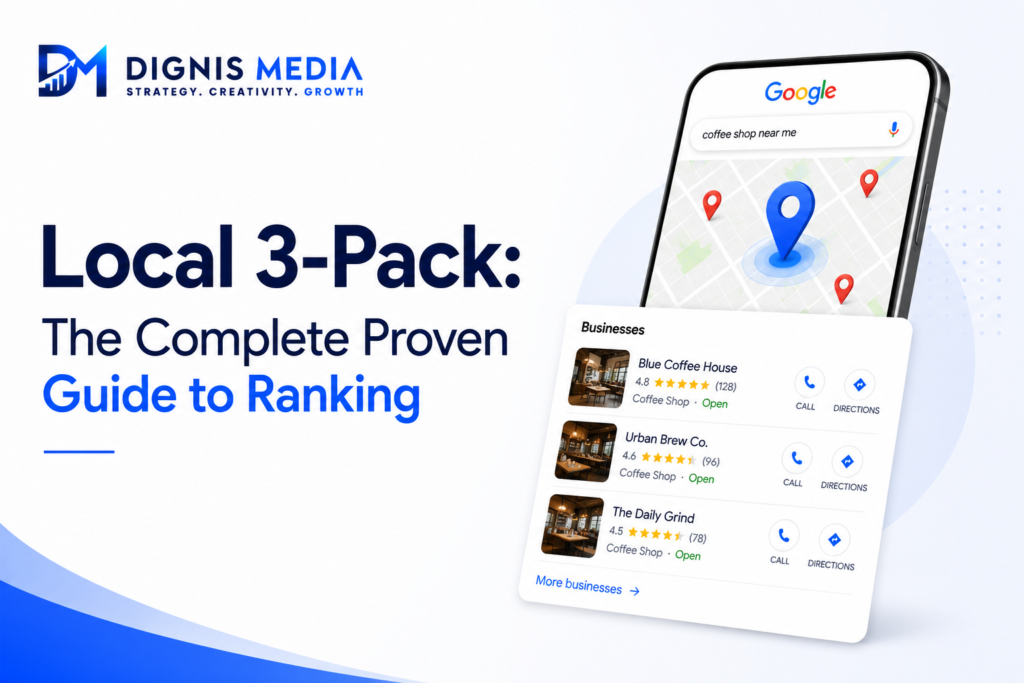
When someone searches for a local service, Google does not lead with a list of websites. It leads with a map, and directly beneath it, three business listings. That block is the Local 3-Pack, sometimes called the map pack or local pack.
Each listing shows the business name, star rating, review count, category, address or service area, hours, and buttons to call, get directions, or visit the website. Everything a customer needs to make a decision, without ever clicking through to a website.
That is what makes the Local 3-Pack so valuable. It is not just a ranking position, it is a complete point of sale. A customer can find you, judge you, and call you without leaving the search page. And crucially, most people never scroll past it. Three businesses capture the attention that dozens of competitors are fighting for.
Why the Local 3-Pack matters more than your website
This is the part most business owners get backwards. They pour money into a beautiful website and wonder why the phone is quiet.
For local search, your website is not what appears first. The Local 3-Pack is. It sits above every organic website result, and it is powered entirely by your Google Business Profile, not by your site. A business with no website at all can rank in the pack. A business with a stunning website can be invisible in it.
That inversion is why understanding the Local 3-Pack changes how you think about local marketing. Your website is your full story for people who are already interested. The pack is how strangers find you in the first place.
How Google decides who gets in
Google is unusually transparent about this. Three factors determine your position: relevance, distance, and prominence. Understanding each one deeply is the foundation of ranking in the Local 3-Pack.
Relevance is how well your business matches what the person searched. This is driven by your primary category above all, then your secondary categories, your listed services, and the language across your profile and reviews. If someone searches “emergency electrician” and your profile says only “electrician,” with no mention of emergency or after-hours work, Google has less reason to show you. Relevance is the most controllable factor, and it is the one most businesses get wrong.
Distance is how close you are to the searcher, or to the location they named. You cannot change where you are. But distance is also why proximity often beats size, and why a small local business can outrank a national brand for a nearby search. It is also why your rank varies by location, appearing strongly near your premises and fading further away.
Prominence is how well known and trusted your business appears. This is built from your review quantity, quality, and recency, your profile activity, your citations across the web, and mentions of your business elsewhere. Prominence is the slow-burn factor, and it is what separates a business that occasionally appears from one that consistently owns a Local 3-Pack position.
The strategic insight is simple. You cannot touch distance, so ranking comes down to pushing relevance and prominence harder and more consistently than the businesses around you.
The factors that genuinely move you
Within those three pillars, certain levers do most of the work. If you want into the Local 3-Pack, concentrate here.
Your primary category. The single highest-impact field on your entire profile. A specialist who picks a broad category loses to a competitor who picked the precise one. Get this right before anything else, because no other work compensates for getting it wrong.
Review velocity and recency. Not just how many reviews you have, but how recently they arrived and whether you reply. A business earning two reviews a week looks alive. One that earned forty reviews two years ago and none since looks abandoned, and Google treats it accordingly.
Profile completeness. Every field filled: services, description, hours, attributes, products, photos. Google rewards complete profiles because they serve users better. Empty fields are ranking left on the table.
Ongoing activity. Regular Google Posts, fresh photos, answered questions. A living profile holds its position; a dormant one drifts down, even after it has earned a spot in the Local 3-Pack.
Citation consistency. Your name, address, and phone identical everywhere online. Inconsistencies erode the trust that prominence depends on.
Engagement signals. Calls, clicks, and direction requests from your profile tell Google people find you useful, which feeds back into ranking. You influence these indirectly by making your profile compelling.
The mistakes that keep businesses out
The same errors come up again and again, and any one can cap you no matter how well you do everything else.
A wrong or overly broad primary category. A business name stuffed with keywords, which violates guidelines and risks suspension. Reviews that dried up months ago. Duplicate listings splitting your signals. Inconsistent business details scattered across old directories. A profile that was set up once and never touched again. And no tracking at all, so you have no idea whether you are rising or falling.
Fixing even one of these can move you noticeably, because most of your local competitors have the same gaps and are not addressing them.
A step-by-step path into the Local 3-Pack
Here is the sequence that actually works.
Step one, claim and verify. Nothing ranks until your profile is verified. Then audit honestly against the three businesses currently in the Local 3-Pack for your main search. What categories do they use? How many reviews, and how recent? How complete are their profiles? That gap is your roadmap.
Step two, fix relevance. Set your primary category with precision. Add accurate secondary categories and every service, written the way customers actually search. Write a natural description including your service and area, without stuffing keywords.
Step three, complete everything. Fill every field, including hours and holiday hours, attributes, products, and at least ten to fifteen genuine photos.
Step four, build review velocity. Set up a simple system to ask every satisfied customer, ideally right after the job. Reply to every review, old and new. Aim for a steady trickle rather than one big burst, which looks unnatural.
Step five, fix your citations. Audit your name, address, and phone across the web and make them consistent everywhere.
Step six, stay active. Post weekly, add photos regularly, answer questions. This is what holds your Local 3-Pack position once you earn it.
Step seven, measure. Track your rankings from multiple locations, not just your own premises, and watch your profile insights. Optimise on data, not guesses.
How long does it take?
Expect early movement within the first month, and a genuine shot at the Local 3-Pack over two to three months. Highly competitive city categories take longer, sometimes three to six months. Quieter suburbs move faster.
Anyone promising you a top-three spot in a few days is either guessing or using tactics that get profiles suspended. Google rewards consistency over time, which is frustrating when you want results now, but it is also exactly why your position becomes defensible once earned. A competitor cannot simply outspend you into the pack.
Frequently asked questions
What is the Local 3-Pack? It is the box of three business listings that appears above organic results for local searches, powered by Google Business Profile. It captures the majority of local clicks and calls.
How do I get into the Local 3-Pack? Set a precise primary category, complete every profile field, build steady genuine reviews, keep your details consistent, and stay active. Those fundamentals, done consistently, are what earn a place.
Do I need a website to rank in the Local 3-Pack? No. The pack is driven by your Google Business Profile. A website helps your overall presence but is not required.
How long does it take to rank in the Local 3-Pack? Early movement is common within 30 days, with real positioning over two to three months, longer in competitive markets.
Why does my Local 3-Pack ranking change depending on where I search from? Because distance is a ranking factor. Your position varies by the searcher’s location, which is why you should check from multiple points in your service area.
Can a new business get into the Local 3-Pack? Yes. A complete, active, well-reviewed new profile can overtake an established but neglected competitor within a few months.
Can I pay Google for a Local 3-Pack position? No. Organic pack positions cannot be bought. Google Ads buys placement above the map, not within the pack itself.
Earn your place in the pack
The businesses in the Local 3-Pack are not the biggest or the oldest. They are the ones whose profiles are the most relevant, the most complete, and the most alive. Every one of those is something you can build. Dignis Media gets Australian businesses into the Local 3-Pack as part of our GMB SEO service and Google Maps Optimisation. For the official factors, see Google’s local ranking guidance.
Related reading: Google Maps Optimisation guide · Google Business Profile categories · Google Maps not ranking? 10 fixes · How to get more Google reviews